Why I Love Symbolic Wedding Ceremonies in Italy — When They Are Done Well

I have to admit it: I am a strong supporter of symbolic wedding ceremonies.
But there is an important condition.
They have to be done well.
A symbolic ceremony should never feel like a substitute for the “real” wedding. It should not try to imitate a civil ceremony, and it certainly does not need to pretend to be religious.
When it is thoughtfully created around the couple, a symbolic ceremony can be one of the most personal, emotional and memorable parts of a destination wedding in Italy.
And sometimes, I actually prefer it.
Legal Doesn’t Necessarily Mean More Romantic
Many international couples assume that if they want their ceremony in Italy to feel truly important, it should also be the moment when they become legally married.
I don’t necessarily agree.
A civil ceremony has a very important purpose: it creates a legal marriage. But legal requirements, official wording and formal procedures do not always create the atmosphere a couple imagines when they picture exchanging vows in an Italian garden, vineyard or historic villa.
There is another possibility.
You can complete the legal marriage in your home country — quietly and simply, if you wish — and save the emotional celebration for Italy.
I sometimes describe it rather unromantically: go to City Hall in jeans, sign the papers and come home married.
And personally? I would save the rings.
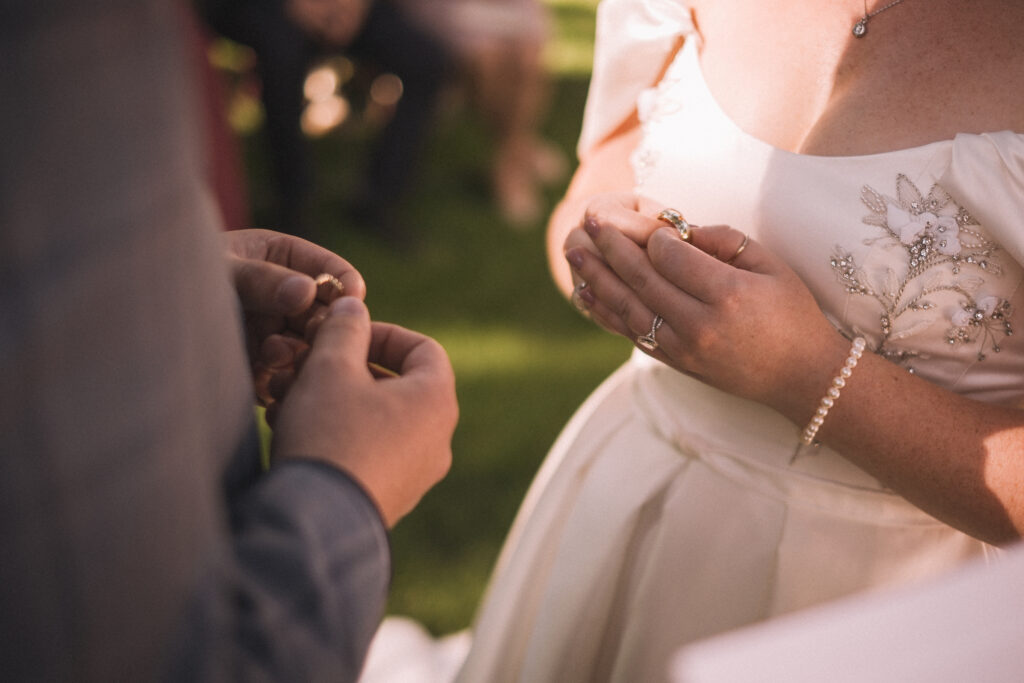
Save the exchange of rings, your personal vows, the music, the entrance, the readings and all those moments you have imagined for the ceremony your family and friends will share with you in Italy.
The paperwork can make you legally married.
It doesn’t have to take away the magic of the ceremony you really want.
A Symbolic Ceremony Is Not a Fake Ceremony
This is perhaps the misconception I dislike most.
A symbolic ceremony has no legal effect, but “not legally binding” does not mean “fake.”
There is nothing fake about promising something to the person you love in front of the people who matter most to you.
And because a symbolic ceremony is not constrained by the same legal structure, we have enormous freedom to make it personal.
Your story can become part of it.
Your celebrant can speak about who you are rather than simply reading a standard text. You can write your own vows, involve family and friends, choose meaningful readings and music, include cultural traditions or create something completely your own.

It can be solemn.
It can be romantic.
It can make everyone cry.
It can also make everyone laugh five minutes later.
The important thing is that it feels like you.
Please, No Fake Priests
Here I have a very definite opinion.
If you want a religious ceremony, I completely understand. A real religious wedding can be extraordinarily beautiful and meaningful for a couple whose faith is part of their lives.
But a symbolic ceremony does not become more important because someone dresses up as a priest.
A symbolic ceremony should never need to pretend to be something it isn’t.
If it is symbolic, let it be proudly symbolic.
Choose a wonderful celebrant. Write a ceremony with substance. Give it rhythm, meaning and personality.
The guests do not need to be persuaded that they are watching something else.
They need to feel that they are watching you get married in the way you chose to celebrate your marriage.
That is enough.
What If You Dream of a Religious Ceremony Outdoors?
Now we arrive at something many couples would absolutely love: a beautiful outdoor ceremony in Italy, with a priest.
This is where things become more complicated.
A Catholic wedding outdoors is not normally the standard option in Italy. Permissions, diocesan rules and local circumstances matter, and what may be possible in one place may not be possible somewhere else.
But “not simple” does not always mean “impossible.”
In my experience, there have been cases where an outdoor Catholic ceremony was possible.
It requires the right circumstances and, above all, a clear understanding of what can — and cannot — be done.
So if an outdoor religious ceremony is something you truly care about, ask before assuming it cannot happen.
But equally, never assume that a beautiful villa and a willing priest are all you need.
This is one of those situations where local knowledge and experience can make a very real difference.
What About a Civil Ceremony at the Venue?
This is another option, and for some couples it is absolutely the right one.
But before choosing it simply because you want your legal marriage and wedding celebration to happen at the same time, ask yourself what matters most to you about the ceremony.
Do you want the legal significance?
Or do you want complete freedom to create the atmosphere, words and structure you have imagined?
Sometimes you can have both. Sometimes there will be compromises.
And sometimes I genuinely believe the better solution is to separate the two: take care of the legal marriage simply, and give the ceremony in Italy all the emotion it deserves.
The Ceremony Your Guests Will Remember
Your guests are probably not going to remember whether a particular sentence was legally required.
They will remember your face when you saw each other.
They will remember the music.
They will remember a father trying not to cry, a friend unexpectedly making everyone laugh, the vows that sounded unmistakably like the two of you.
They will remember how the ceremony felt.
That is why I am such a supporter of symbolic ceremonies when they are done properly.
Not because the legal part of marriage is unimportant.
But because legal validity and emotional meaning are two different things — and they do not always have to happen in the same place or on the same day.
A symbolic ceremony gives us the freedom to concentrate completely on the second.
And when we do it well, nobody should leave thinking:
“That was only a symbolic ceremony.”
They should simply leave thinking:
“That was completely them.”