What If It Rains on Your Wedding Day in Italy?
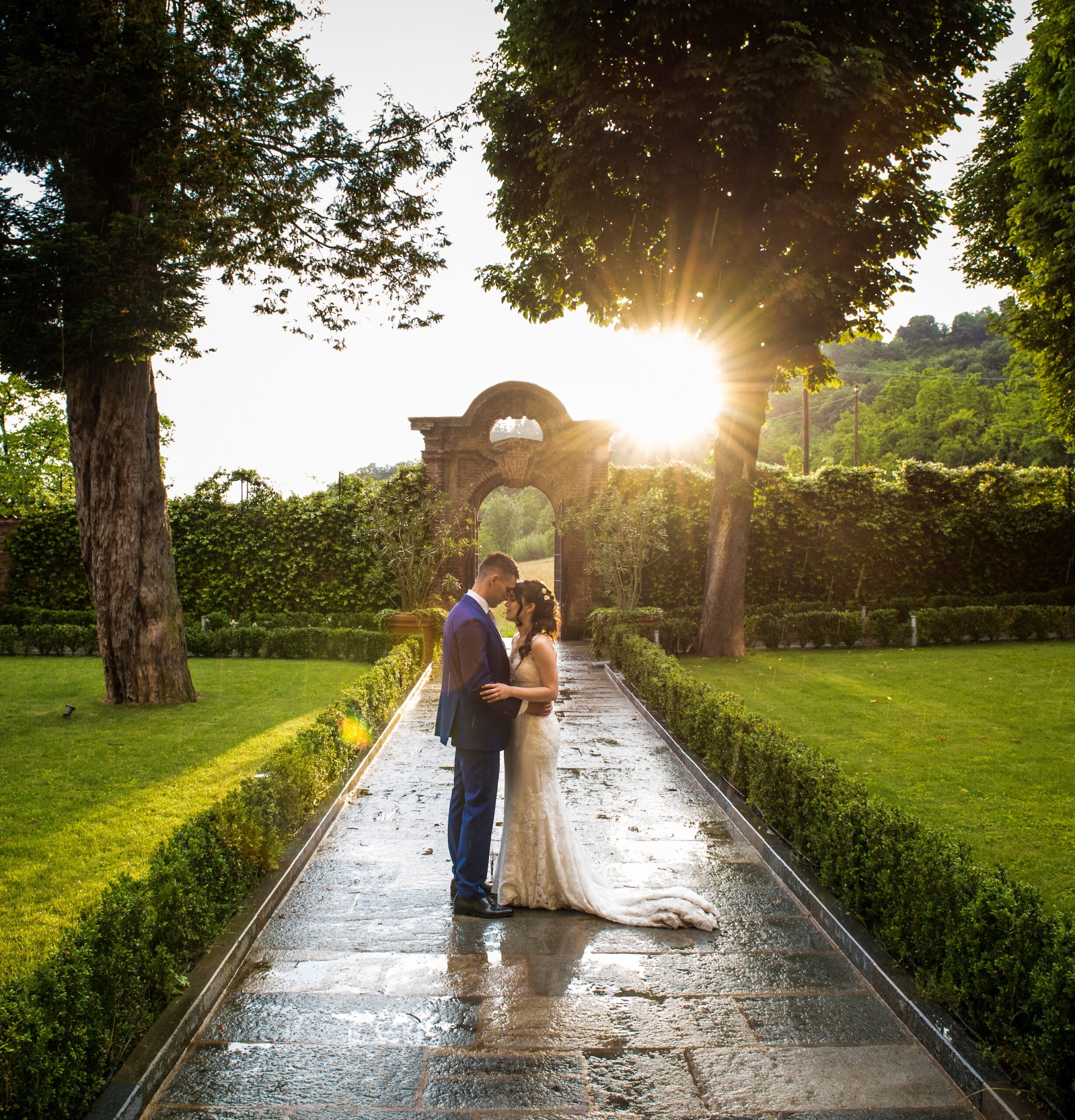
There’s something every wedding planner learns very quickly: in the days leading up to a wedding, you develop an almost obsessive relationship with the weather forecast.
You check it. Then you check it again. You compare different websites.
One says sunshine. Another shows a cloud. Another announces a slightly alarming 30% chance of rain at exactly the time of your ceremony.
And suddenly, that 30% seems to occupy 100% of your thoughts.
But after many years of weddings, I’ve learned that rain itself isn’t really the problem.
Uncertainty is.
When we know with reasonable certainty that it’s going to rain, we can prepare for it. The difficult situation is when it might rain.
Or it might not.
And that’s exactly why a good Plan B isn’t something you start thinking about when a little rain cloud appears on your weather app.
You plan it much earlier.
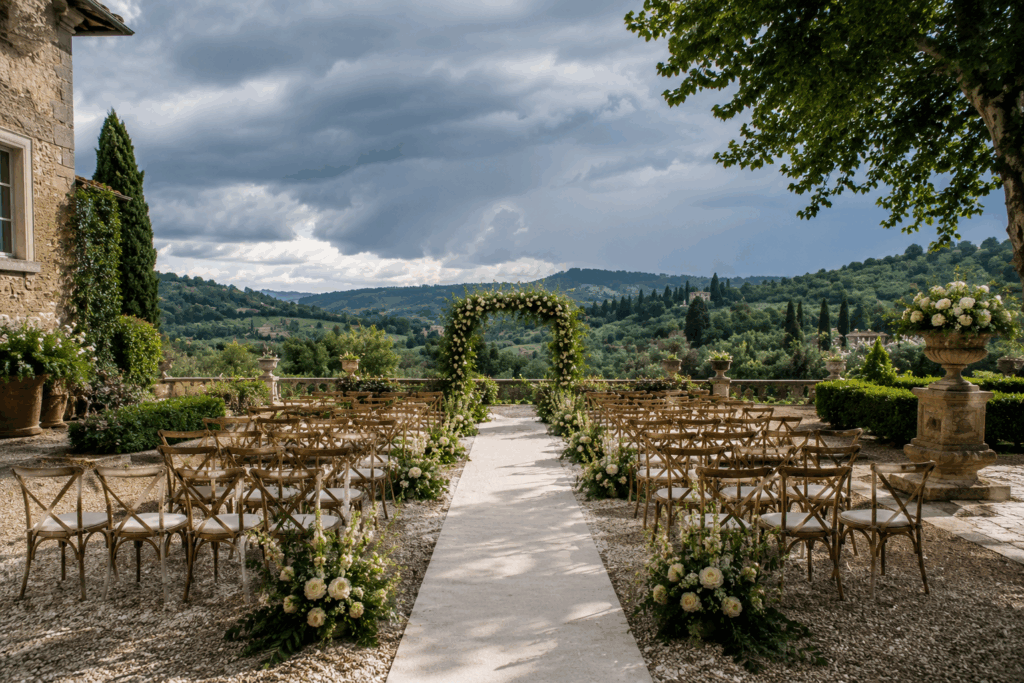
A Plan B Isn’t Simply “We Have an Indoor Space”
Whenever I visit a venue, there’s one question I always ask:
“What happens if it rains?”
The reassuring answer seems to be: “No problem, we have indoor spaces too.”
For me, that’s where the conversation begins.
How many guests can those spaces actually accommodate comfortably? Where would the ceremony take place? What about the cocktail hour and dinner?
If everything has to move indoors, can each part of the wedding still have its own atmosphere, or will your guests spend hours in the same room?
And how long would it take to change the setup? How late can the caterer, florist, musicians and other vendors wait before they need a final decision?
Because a real Plan B shouldn’t simply be somewhere to put your guests if it rains.
It should be a second version of your wedding.
Different, certainly. But just as beautiful — if not even more so.
There’s one very simple rule I suggest remembering when you visit a venue:
If your Plan B already makes you sad during the venue tour, it probably isn’t a very good Plan B.
When the Plan B Is Already Part of the Venue
Not every Italian wedding venue has large indoor spaces. Sometimes capacity is limited, particularly in historic properties where there may also be restrictions on how certain areas can be used.
For this reason, many venues already have permanent or semi-permanent covered structures designed to host the reception when the outdoor spaces cannot be used.
And they are worth looking at carefully.
Because these structures are not all the same.
Some are beautiful. Others… decidedly less so.
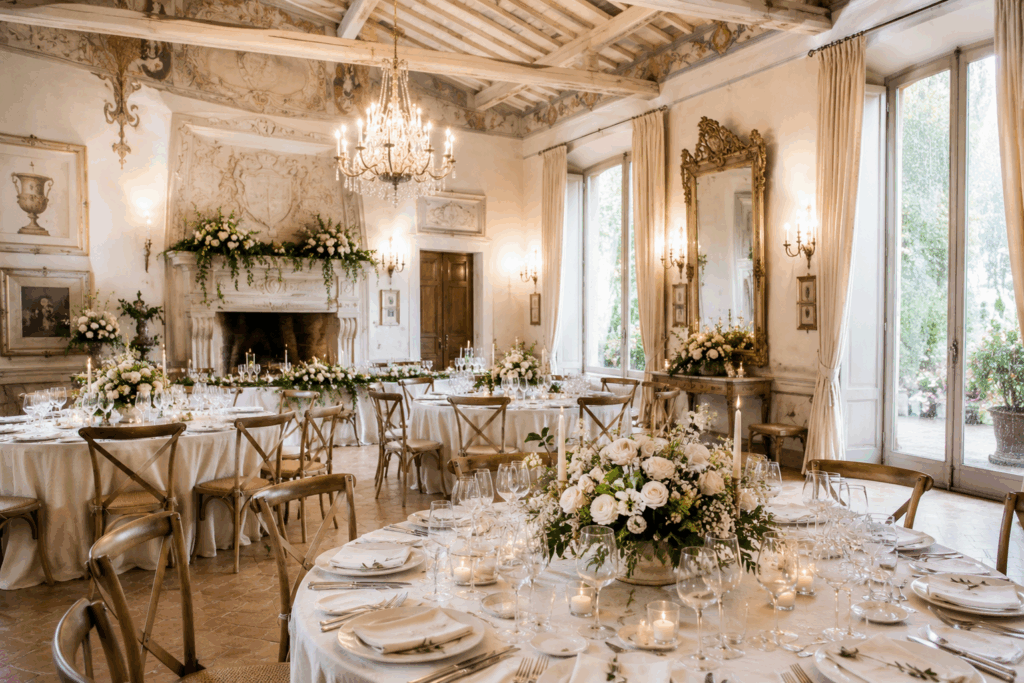
The best ones can be light-filled, elegant and beautifully integrated into their surroundings. With the right lighting, flowers and furnishings, they can become one of the most beautiful spaces of the entire wedding.
So when you visit a venue, don’t look only at the garden where you’re imagining dinner under the stars.
Ask to see where you would have dinner if those stars decided to hide that night.
Because it isn’t enough for a Plan B to exist.
You should be happy to use it.
What If the Venue Doesn’t Have One?
In that case, a professional wedding tent — or marquee, as British couples may know it — can be reserved well in advance as a backup.
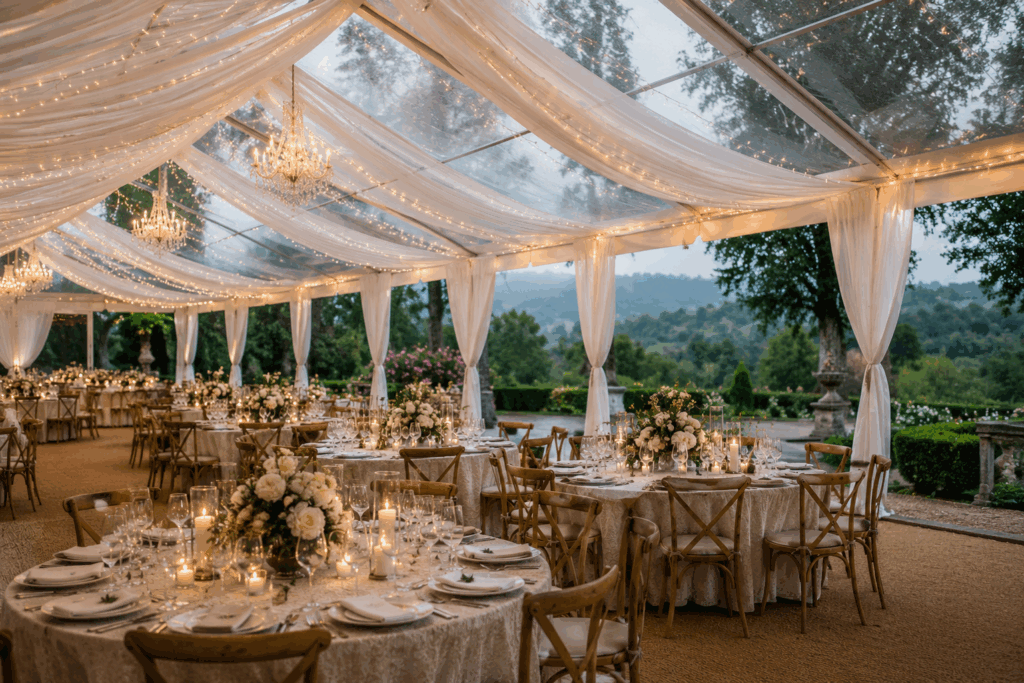
And if the word tent makes you imagine a simple garden canopy, forget it.
Today’s wedding tents can be sophisticated structures and, when thoughtfully designed, furnished and decorated, genuinely beautiful.
But they can’t be booked when the first raindrops begin to fall.
Availability is reserved well in advance. Typically, an initial deposit is paid — often around 10–15% — and the final decision about installation is made approximately three days before the wedding, when the forecast has become much more reliable.
If the weather looks good, the structure isn’t installed and, depending on the terms of the contract, the company generally keeps only the deposit.
If it’s needed, it is installed and the remaining amount is paid according to the agreement.
I think of it as a kind of wedding insurance.
You hope you won’t need to use it. But when a venue doesn’t have a real Plan B of its own, I always recommend having one in place.
Your Plan B Starts Long Before You Check the Forecast
And it isn’t only about rain.
Think about heat.
If you’re planning an outdoor ceremony, we shouldn’t discover during wedding week that at 4 p.m. the ceremony area is sitting in full sun.
During the planning process, we look at the exposure, how the sun moves across that particular space at that time of year, and typical temperatures. The ceremony time can then be chosen accordingly.
Because an outdoor ceremony can be wonderful.
A hundred beautifully dressed guests desperately searching for one tiny patch of shade, considerably less so.
In reality, weather planning starts months before the wedding, when none of us has any idea what the forecast will be.
Then Comes the Moment When Someone Has to Decide
There is no universal moment when someone looks at the sky and announces:
“Okay. Plan B.”
The caterer needs to know where to prepare and serve. The florist needs to know where to set up. Chairs, tables, music, lighting and décor may all need to be moved.
And some decisions can’t be reversed five minutes before your guests arrive.
That’s why I want to know well in advance how long it would actually take to move from Plan A to Plan B — and when we reach the point when we can no longer wait.
When that moment comes, my job is to gather the information, talk to the venue and vendors, assess the consequences of each option and give the couple everything they need to make an informed decision.
Except in rare circumstances, the final decision is theirs.
No wedding planner can promise that it won’t rain. And no wedding planner should lightly decide to abandon the wedding a couple has imagined for months.
Sometimes good planning means changing the plan.
Sometimes it means having the courage not to change it.
My First Wedding Taught Me That
I was in church coordinating the ceremony at my very first wedding as a wedding planner when the caterer called me.
The weather was threatening rain, and he wanted to set up the cocktail hour indoors.
It was an understandable choice. But it would have meant giving up everything we had planned for the outdoor cocktail hour before we even knew whether it was really necessary.
I asked him to give me some time.
My assistant and I started checking every forecast we could find. We were among the hills of southern Monferrato, where the internet connection came and went. At the same time, I had someone at home checking several other weather services, including international ones, and keeping us updated.
I spoke to the caterer several times.
His position was very clear: if we kept the cocktail hour outside and it started raining, the service would stop immediately.
So this wasn’t a decision without consequences.
Finally, I spoke to the owner of the property.
He told me something I still remember:
“This place is blessed by the gods,” he told me. “It hardly ever rains here.”
I had gathered all the information I could. I had the forecasts, I could look at the sky, and I had the opinion of someone who knew that particular place far better than I did.
I had to make a decision.
I decided to trust it.
The cocktail hour would stay outside.
Not a single drop of rain fell.
Not during the cocktail hour.
Not during the entire wedding.
That doesn’t mean I knew I was right.
It means I had enough information to make a decision — and, that time, I accepted the responsibility of making it.
And Sometimes the Sky Changes Its Mind
Years later, I was coordinating a wedding in the Piedmont countryside.
We were in the middle of the civil ceremony, held on a spectacular panoramic terrace overlooking the hills, with around 150 guests seated outdoors.
The forecast had been perfect.
Then I looked up.
A large, dark gray cloud was heading straight toward us.
I was standing about thirty feet from the officiant and started trying to catch her eye, discreetly pointing toward the sky and signaling that we needed to shorten the ceremony.
There was just one small problem.
A friend of the couple was singing live and, at precisely that moment, launched into an Ave Maria that seemed determined never to end.
Let’s just say that, for a few interminable minutes, he appeared to think he was performing his own private concert.
Eventually, the officiant caught my increasingly urgent signals. The ceremony came to a beautiful — although slightly faster than planned — conclusion, and all 150 guests moved indoors, where the cocktail hour was already scheduled to take place.
The forecast had been perfect. The sky simply hadn’t read it.
Keeping Plan A had been the right decision.
But being prepared also meant knowing what to do when something suddenly changed.
A good Plan B is about spaces. A great Plan B is also about decisions.
“It Never Rains at My Weddings”
During my first conversations with a couple, I sometimes joke:
“It never rains at my weddings.”
It’s almost true.
Over the years, I’ve been extraordinarily lucky with the weather. On the few occasions when we did have rain, it was forecast with enough certainty for us to prepare properly.
Of course, I don’t have a secret agreement with the Italian weather.
And I would never promise a couple that it won’t rain.
But perhaps precisely because I’ve been so lucky, I’ve never stopped preparing for the possibility that one day it will.
We can choose a venue where your wedding will still be beautiful if the weather changes its mind.
We can create an alternative that doesn’t feel like a compromise.
And we can know, long before the first cloud appears, which decisions we may have to make.
You can’t control the weather. But you can plan for it.
Daniela
Have something you’d like to ask me?
Whether it’s a question, something you’re unsure about, or simply something you’re curious about, write to me. I’ll be happy to talk about it with you.