How Much Does a Wedding Planner in Italy Cost? What You’re Really Paying For
If you’re planning a destination wedding in Italy, sooner or later you’ll probably ask this question:
How much does a wedding planner in Italy cost?
The simplest answer would be to give you a number. But it would also be a rather unhelpful answer.
You might receive one proposal for €3,000, another for €6,000, and another for €10,000. You might find a fixed fee, a percentage of your overall wedding budget, or a combination of the two.
And behind apparently similar numbers, you may find very different levels of service.
So before comparing prices, it’s worth understanding what you’re actually paying for.
How Much Does a Wedding Planner in Italy Cost?
There is no standard fee.
The cost depends on the type of service, the complexity of the wedding, the number of guests, how long the planning process will last, the destination, the number of events involved, and, of course, the planner’s experience and level of involvement.
For full-service wedding planning in Italy, fees can vary significantly depending on the complexity of the wedding and the level of service involved.
There are also different ways planners structure their fees.
Some work with a fixed fee.
Others charge a percentage of the overall wedding budget.
Others use a hybrid model: a fixed fee up to a certain budget threshold, plus a percentage of the amount above it.
None of these systems is necessarily better than another.
The important question is:
What exactly does that fee include?
Two Proposals Aren’t Necessarily Comparable
This is one of the easiest mistakes to make.
Planner A: €4,000.
Planner B: €7,000.
Planner A obviously looks less expensive.
But is she?
Before deciding, find out exactly what each service includes.
Is venue research included?
How many venues will be selected for you?
Is budget management included?
What about vendor research and coordination?
Site inspections?
Are travel expenses included or charged separately?
Guest logistics and transportation?
Welcome dinners and other events?
Assistance with ceremony paperwork?
Will the planner be present throughout the wedding weekend?
And then there is the team.
Does the planner work alone, or is there a team supporting her during the wedding? How many people will be there, and what will their roles be?
For a destination wedding, there is another question I consider particularly important:
Does the team speak fluent English?
It may not be enough for the planner you’ve met on your Zoom calls to speak English.
During the wedding, she may be with you while another member of the team is handling arriving guests, transportation, a logistical issue, or simply answering someone’s questions.
They need to be able to communicate.
Finally, if the planner’s fee is based entirely or partially on your wedding budget, ask how her fee will change if your final budget increases.
Only after you have these answers do two numbers really become comparable.
What Are You Really Paying For?
Some parts of a wedding planner’s work are easy to see.
Venues, catering, flowers, music, photography, timelines, coordination.
But a much larger part of the work remains invisible.
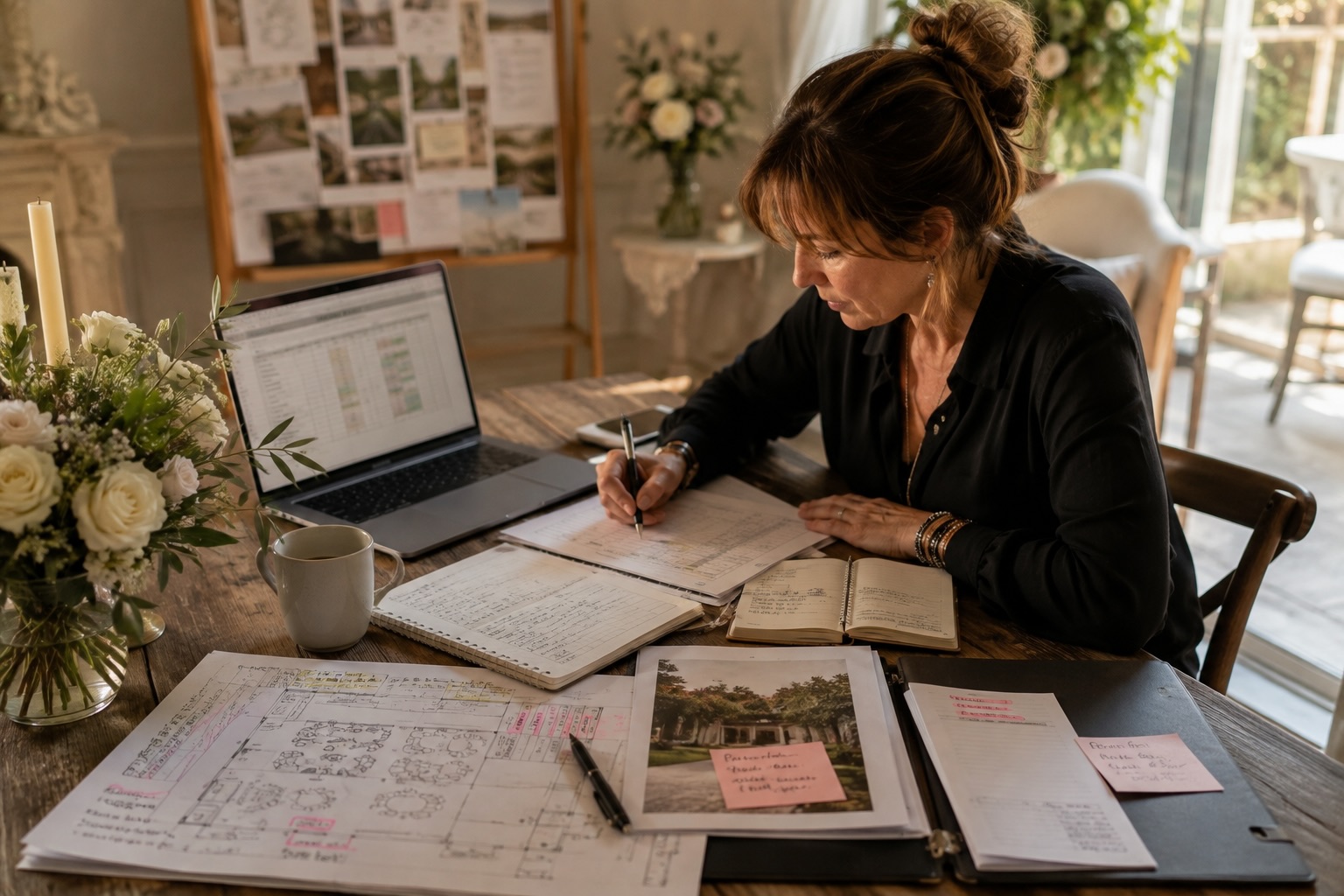
It’s the time spent checking availability, comparing proposals, reviewing contracts, building and updating budgets, communicating with vendors, arranging site inspections, coordinating different people, anticipating problems, and finding solutions before those problems ever reach the couple.

And then there is something much harder to put on a proposal:
professional judgment.
Knowing when a venue that looks perfect isn’t actually right for that particular wedding.
Recognizing when something is missing from a quote.
Knowing which questions to ask a vendor.
Realizing that a logistical plan that works perfectly on paper will be uncomfortable for your guests in real life.
Creating a Plan B that isn’t simply “an indoor space,” but an alternative where you would still be happy to celebrate your wedding.
Experience is especially valuable here:
seeing things in advance that a couple planning a wedding for the first time may simply have no reason to know.
When a Very Low Fee Should Make You Ask More Questions
A high price doesn’t automatically guarantee excellent service.
And a low price doesn’t automatically mean poor service.
But when you’re comparing fees for full-service wedding planning, a surprisingly low price should make you ask more questions, not fewer.
Planning a destination wedding carefully takes a significant amount of time.
Depending on the complexity of the wedding, full-service planning can easily require at least around 200 hours of professional work, and more complex celebrations may require considerably more.
Try a simple exercise.
Take those 200 hours and multiply them by a normal professional hourly rate where you live.
That is not necessarily how a wedding planner calculates her fee. But it is a useful way to put hundreds of hours of professional work into perspective — and to understand why an unusually low full-service fee deserves a closer look.
Because behind a planning fee there aren’t only the planner’s hours. There may also be a team, professional tools, business expenses, organization, and everything required to look after a wedding carefully over many months.
So if you receive a considerably lower proposal, don’t automatically assume you’ve found a bargain.
Instead, ask:
What makes it possible to provide this level of service at this price?
How many weddings does the planner manage at the same time?
How much time can she realistically dedicate to yours?
Will venue and vendor research be tailored specifically to you, or will it rely largely on standardized selections?
Will you have the same point of contact throughout the planning process?
Is there a team?
Who will actually be there during your events?
A lower fee may be completely appropriate for a more limited service.
But if you’re being offered highly personalized, full-service planning at an exceptionally low price, it’s worth understanding what makes that price possible.
The risk isn’t necessarily receiving poor service.
It may simply mean receiving less time, less attention, or a much more standardized planning process than you expected.
Will a Wedding Planner Save You Money?
Not necessarily.
And I would be cautious of anyone who promises that as a rule.
An experienced planner can help you avoid costly mistakes, use your budget more effectively, understand where it makes sense to invest, and recognize where additional spending may not actually add value to your wedding.
But that doesn’t mean her fee will magically disappear because of the money she saves you.
Wedding planning has a cost because it is a professional service.
Its value also lies in how your budget, your time, and your possibilities are used.
Do You Really Need a Wedding Planner?
Not every couple does.
If you love researching, have plenty of time to dedicate to planning, feel confident comparing vendors and contracts, and genuinely want to manage every aspect of your wedding in Italy yourselves, you may be perfectly happy planning it without a wedding planner.
And that’s absolutely fine.
But if you’re considering hiring one, don’t compare her fee simply with the idea that “doing it ourselves is free.”
You’re comparing two very different experiences.
A wedding planner shouldn’t take control of your wedding away from you.
She should give you the information, options, and experience you need to make better decisions.
So, How Should You Choose?
I would never choose a wedding planner based on her fee alone.
Look at her work, of course.
But read the reviews from couples who have actually worked with her. They can often tell you far more than beautiful photographs.
Ask questions.
Ask how she selects venues, how she builds and manages the budget, how she chooses vendors, how she deals with unexpected problems, how personally involved she will be, and what happens after you sign the contract.
But most importantly:
listen to her.
Try to understand whether there is pragmatic, logical thinking behind what she proposes.
Can she explain why one choice may work and why another may not?
Does she ask questions before giving you answers?
Can she see your wedding as a whole, rather than focusing only on the beautiful, photogenic parts?
Because a wonderful wedding certainly needs lots and lots of flowers.
But it also needs someone who knows what to do when those flowers have to arrive at the right place, at the right time, while fifty other things are happening at once.
You’ll be trusting this person with months of decisions, an important part of your budget, and a day that will bring together the people you love most in Italy.
Price matters.
But just as importantly, you need to trust the way that person thinks.