Did Ronaldo Already Blow the Wedding Budget on Georgina’s Ring?
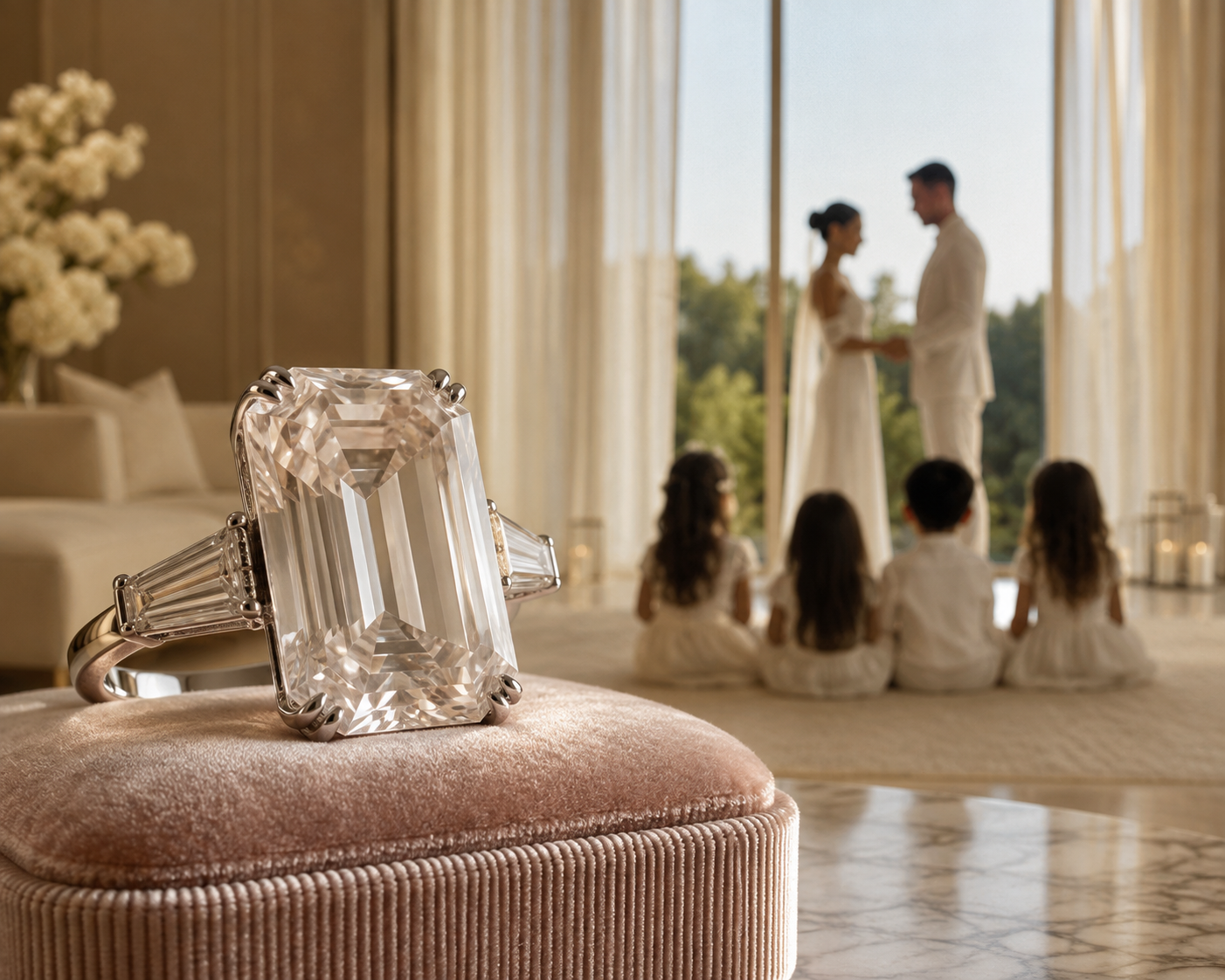
Maybe Cristiano Ronaldo simply blew the wedding budget on Georgina’s ring.
It would certainly be a funny explanation.
After all, when one of the world’s most famous and wealthy couples decides to get married, it is difficult not to imagine something spectacular: an impossible-to-book venue, hundreds of guests, flowers everywhere, international entertainment, and everything an almost unlimited budget can buy.
Instead, Cristiano Ronaldo and Georgina Rodríguez chose something completely different: a private ceremony at their home in Cascais, surrounded by their five children.
Of course, considering the ring — and the jewelry Georgina wore — we can reasonably rule out a sudden need to economize.
And that is precisely what makes their choice so interesting.
Because perhaps luxury weddings are not disappearing.
Perhaps luxury is simply changing its language.
A Simpler Wedding Is Not Necessarily a Less Expensive One
For years, weddings have become increasingly spectacular: monumental floral installations, elaborate tablescapes, champagne towers, extraordinary quantities of flowers, and the constant search for an image capable of stopping the scroll on Instagram.
Now something seems to be moving in a different direction.
We hear more about quiet luxury, authenticity, natural materials, long convivial tables, local cuisine, intimate celebrations, and designs that appear simpler and less constructed.
But it would be very easy to misunderstand this change.
Simple does not mean inexpensive.
And it certainly does not mean that couples necessarily want to spend less.
They may simply be becoming much more selective about where they want to spend.
A New Generation Is Entering the Wedding Market
Gen Z is reaching marrying age at a financially complicated time.
At the same time, something apparently contradictory is happening.
Younger consumers can be extremely careful with money while still being willing to spend significantly on something they consider truly worthwhile.
The difference may lie in one word:
value.
Not simply:
How much does it cost?
But:
Is this really worth that much to us?
And that question can completely change a wedding.
Fewer Flowers Do Not Necessarily Mean a Smaller Budget
Imagine two couples with exactly the same wedding budget.
One may want spectacular floral installations, an elaborate tablescape, and a visually impressive production.
The other may choose a much simpler design and put that same money toward extraordinary food, exceptional wines, music, hospitality, or an entire weekend with their guests.
Which one is having the more luxurious wedding?
The answer is: it depends on what luxury means to them.
For one couple, luxury may be walking into a room completely transformed by flowers.
For another, it may be an extraordinary chef, a remarkable bottle of wine, or three days spent with people who crossed an ocean to be there.
The money has not necessarily disappeared.
Its destination has changed.
But What If Authenticity Becomes Just Another Trend?
There is a risk here.
For years, we watched weddings increasingly resemble the images gaining the most attention on Instagram and Pinterest.
If we now decide that the contemporary wedding must feature one long table under the trees, fewer flowers, natural materials, and an apparently effortless aesthetic, we have not necessarily discovered authenticity.
We may simply have created a new uniform.
A wedding does not become personal because it has fewer flowers.
It does not become authentic because it takes place in the countryside.
And it does not automatically become sophisticated because we call it quiet luxury.
Authenticity begins when decisions come from the couple rather than from the trend of the moment.
If you genuinely love spectacular floral installations and have the budget to create them, do it.
If you have always dreamed of a wedding for three hundred people, an orchestra, and a monumental production, do it.
Authenticity is not measured by the number of flowers or guests. It is measured by how much the wedding actually represents you.
The point is not to replace the extravagant wedding with the minimalist wedding.
It is to stop believing that there is only one correct way to express luxury.
From Status to Experience — But Not the End of Status
The luxury market itself is observing an interesting shift.
That does not mean status has disappeared.
It may simply be expressed differently — through identity, uniqueness, access, personal meaning, or experiences rather than through obvious displays of wealth alone.
Traditional luxury could say:
“Look what I can afford.”
Contemporary luxury may increasingly say:
“This is what I believe is worth paying for.”
And those two ideas can coexist.
Couples with enormous financial resources who want extraordinary productions will continue to create them — and when they are beautifully designed, they can be magnificent.
What they increasingly have in common is the desire for something that feels personal.
For couples with substantial, rather than unlimited, budgets, that leads to a much more interesting question:
Where do we want to put the value?
Maybe Luxury Has Become Personal
Which brings us back to Cristiano and Georgina’s living room.
A couple who could have chosen almost any destination, any production, and almost any budget chose to marry at home with their children.
One celebrity wedding is certainly not statistical evidence of a generational shift.
But as a symbol of this particular moment, it is fascinating.
Because it reminds us that being able to choose everything does not necessarily mean wanting to display everything.
Perhaps that is the most interesting part of what is happening in weddings right now.
We are not necessarily moving toward cheaper weddings.
We are not necessarily moving toward smaller weddings.
And we are certainly not witnessing the end of luxury.
We may simply be entering a time when luxury is defined less by how much we can display and more by what we consciously choose to experience.
So perhaps the question couples should ask when planning their wedding is no longer:
“How can we make it look luxurious?”
But:
“What does luxury mean to us?”
And if the answer is getting married at home with your five children, wonderful.
Just make sure somebody left something in the budget after buying the ring.